







When global events reach the rooftop

By John Kenney, Cotney Consulting Group.
Why every roofing contractor needs an operational preparedness plan
Forty-five years ago, when I entered the roofing industry, running a successful company meant mastering the challenges we could see. We watched the weather forecast as closely as the production schedule. We worried about keeping crews busy, delivering quality work, controlling labor costs and finding enough projects to keep everyone employed. Material prices moved from time to time, but the forces driving those changes were usually much closer to home.
Today, roofing contractors operate in a completely different world. A drone strike on a refinery halfway around the globe can influence diesel prices. A disruption in international shipping can affect insulation lead times. Political instability on another continent can eventually show up in freight charges, manufacturing schedules and supplier quotes.
That isn't politics. It's modern business.
Recent events involving Russia, Ukraine and Iran have again demonstrated how interconnected the global economy has become. Our responsibility as roofing contractors is not to debate foreign policy. It is to understand how events like these can influence the businesses we lead.
Maybe not tomorrow or next week, but history has shown that global disruptions eventually affect our estimates, purchasing decisions, project schedules and profitability.
One lesson I have learned over more than four decades is that contractors rarely lose money because of one catastrophic event. Profits more often disappear through small adjustments: fuel rises, freight increases, lead times stretch, suppliers revise pricing, a second delivery becomes necessary or a project starts two weeks late. Individually, each issue may seem manageable. Together, they can quietly erase the margin that looked healthy when the estimate was prepared.
That is why operational preparedness has become one of the most important responsibilities of today's roofing executives.
The week that changed the conversation
Recent headlines centered on military conflict, but another story was unfolding beneath them. Ukraine continued targeting Russian energy infrastructure, including refineries that produce diesel and other petroleum products. Russia then temporarily restricted diesel exports to protect domestic supply. At the same time, tensions involving Iran created additionaluncertainty in global energy markets and major international shipping routes.
To most people, these developments may seem unrelated to construction. Experienced roofing contractors should pay attention.
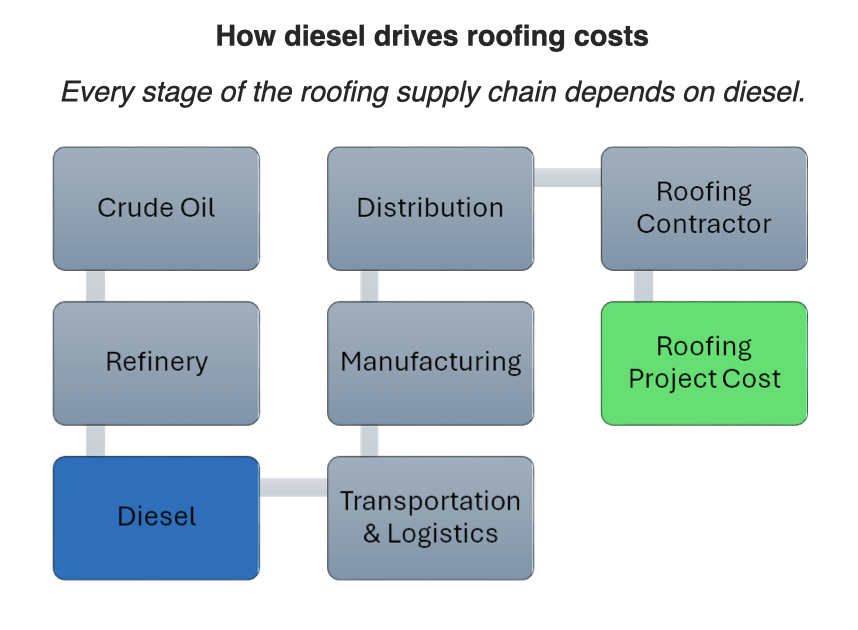
Modern roofing materials do not simply appear at the local distributor. Insulation, membranes, adhesives, fasteners and sheet metal move through a supply chain that involves raw materials, chemical production, refining, transportation, manufacturing, distribution and warehousing. Every step requires energy, transportation and cost.
When disruption occurs at one point in the chain, pressure rarely stays isolated. Eventually, someone pays more. The question is where that additional cost enters the system.
This is not about predicting wars or forecasting energy markets. It is about understanding operational risk. Leadership is rarely about perfectly predicting the future. It is about recognizing change early enough to make better decisions than your competitors.
 Why diesel matters more than oil
One common misconception is that watching crude oil prices tells contractors where construction costs are headed. In reality, diesel often tells a more immediate story. Think of it this way.
Every stage of our industry depends on diesel. It moves raw materials to manufacturers, products across the country and roofing materials to distributors and jobsites. It fuels cranes, forklifts, generators, service trucks, waste haulers and heavy equipment.
Long before a crew begins installing a roof, diesel has influenced many of the costs built into that project.
Even when crude prices remain relatively stable, a loss of refining capacity can tighten diesel supplies. Freight costs rise; manufacturers pay more to move materials; distributors absorb higher transportation expenses; and contractors eventually see increases in delivery, equipment and material costs.
I have always viewed diesel as the bloodstream of construction. When the continuous movement of materials becomes restricted or more expensive, every part of the system feels the effects.
Understanding crack spreads without an economics degree
If you follow energy markets, you may hear analysts discuss crack spreads. The term sounds technical, but the basic idea is straightforward.
For a simplified illustration, imagine crude input worth $70 produces a basket of refined products worth $135. The difference is a rough proxy for the refinery's gross margin, commonly called a crack spread. It is not the refinery's final profit because it does not include all operating costs, but it shows the relationship between crude input costs and refined product prices.
Higher crack spreads do not necessarily mean crude oil is scarce. They can mean refined products, particularly diesel, have become more valuable because supply is tight or refining capacity is constrained.
For roofing contractors, that stress often appears first in diesel markets. Weeks later, it begins to show up in freight invoices, supplier quotes, equipment costs and project budgets.
Understanding that connection does not make you an economist. It makes you a better business leader.
Why roofing contractors should care
Nearly everything we do touches diesel. Suppliers use it to move materials from plants to distribution centers. Distributors use it to replenish inventory and deliver to jobsites. Crane companies, trucking firms, waste haulers and equipment-rental providers depend on diesel-powered equipment. Service fleets burn fuel every day.
These expenses usually do not arrive as one dramatic increase. They appear as freight adjustments, fuel surcharges, higher delivery charges, increased disposal costs, added mobilization and schedule changes caused by longer lead times.
Each adjustment may seem manageable. Collectively, they can erase thousands of dollars in profit before substantial completion.
Successful contractors do not wait until those increases appear on an invoice. They monitor the conditions creating them because protecting profitability begins long before the first bundle of material reaches the jobsite.
The MDI lesson isn't going away
For commercial roofing contractors, the discussion of insulation is immediately familiar. Polyisocyanurate insulation has demonstrated how vulnerable a supply chain can become when a critical raw material such as MDI is constrained.
Contractors have experienced the effects of shortages, allocation programs, longer lead times and rapidly changing prices. The lesson is not simply that MDI became difficult to obtain. It is that chemical production, energy, refining, transportation and distribution are connected.
Fuel problems do not replace chemical shortages; they amplify them.
An estimator may use last month's insulation pricing. A project manager may assume normal lead times. A salesperson may promise an installation date based on yesterday's availability. By the time of contract award, the assumptions supporting the job may already have changed.
Fuel, freight, insulation and material availability cannot be managed as separate issues. Understanding how they interact gives leadership teams time to make better decisions before the market forces them to.
Understanding the roofing cost cascade 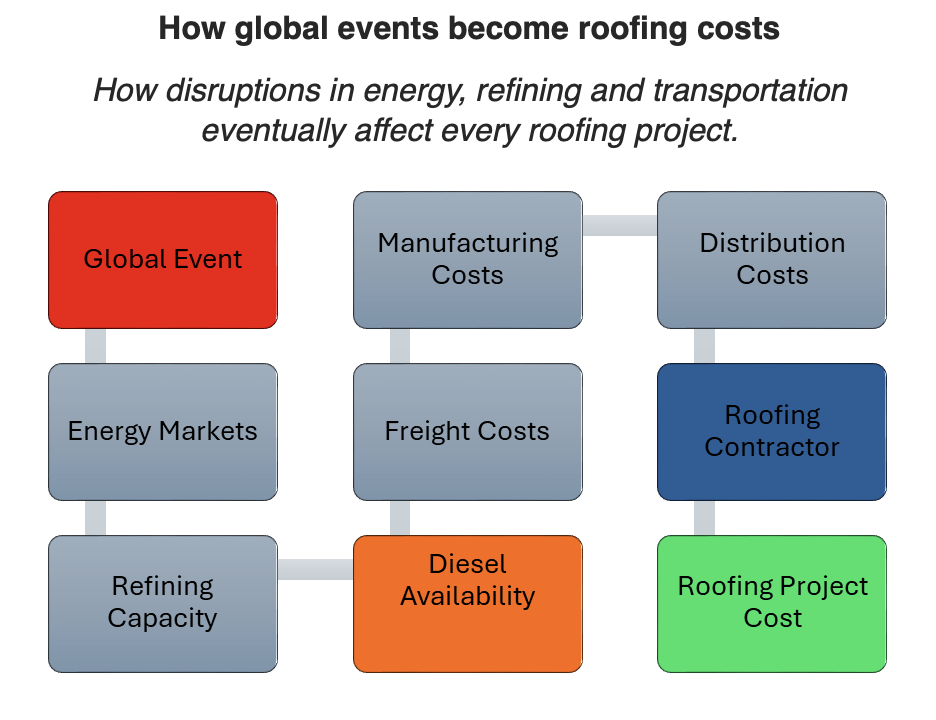
Cost increases do not begin when a supplier changes a price. The supplier is often one of the last participants affected. The process may begin weeks or months earlier as one disruption creates the next consequence.
The farther upstream a disruption begins, the more time contractors may have to prepare, provided they are watching the right indicators. This is what I call the Roofing Cost Cascade.
By the time a supplier announces an increase, the market may have been adjusting for weeks. Prepared contractors stop asking only, “Why did prices go up?” They also ask, “What indicators are telling us prices could change?”
The goal is not to predict the future. It is to reduce surprises.
Operational preparedness is a competitive advantage
Years ago, operational preparedness usually meant planning for hurricanes, severe weather or seasonal workload changes. Today, it means building an organization capable of adapting to disruption regardless of where it begins.
Preparedness is not predicting the next crisis. It is creating systems that allow your company to respond faster and more intelligently when conditions change.
Average companies react after suppliers announce a change. Exceptional companies are already discussing possibilities with suppliers before making formal announcements. Average companies scramble to protect margins. Exceptional companies build protection into estimating, procurement and financial planning before the disruption reaches the job.
Preparedness does not eliminate uncertainty. It creates options, and options are among the greatest competitive advantages a roofing company can possess.
The five pillars of operational preparedness
- Supplier diversification: Strong relationships matter, but no contractor should be overly dependent on one manufacturer, distributor or product line. Know your approved alternatives before you need them.
- Financial flexibility: Volatile markets expose weak cash flow quickly. Healthy reserves, disciplined financial controls and available credit give a company time and choices.
- Estimating discipline: Every estimate should use verified supplier pricing, realistic freight assumptions, clear quote expiration dates and appropriate escalation language. An estimate is not simply a selling document; it is a risk-management document.
- Operational execution: Procurement timing, material sequencing, storage, delivery coordination and communication are not administrative tasks. They are profit-protection activities.
- Leadership awareness: Roofing executives do not need to become economists, but they do need to understand fuel, freight, labor, insurance, interest rates, commodities, weather, supplier health and global supply chains. Leadership requires seeing beyond the jobsite.
Estimating during volatile markets
This is where profitability is protected or quietly surrendered. Estimating is about more than mathematics; it is about managing uncertainty.
Every estimate includes assumptions about labor productivity, material pricing, equipment, freight, fuel, waste, travel, storage and delivery timing. The best estimators do more than verify the numbers. They ask whether the assumptions behind those numbers remain valid.
During volatile markets, quote-validity periods may need to be shorter. Supplier confirmations should become routine. Freight assumptions and insulation pricing should be rechecked before major proposals are submitted. Escalation language should be discussed with customers before award, not after costs have moved.
Some contractors worry these conversations will make proposals harder to sell. Perhaps they will. But losing a project after explaining the risk honestly is better than winning one that loses money because the risk was ignored.
Professional communication builds trust. Surprises destroy it.
Project management during supply volatility
Once the contract is signed, the risk moves from estimating to operations. Every unnecessary reorder becomes more expensive because the company is not only replacing material; it may also be paying additional freight, equipment time, labor disruption and administrative cost.
Project managers who look several weeks ahead consistently outperform those focused only on today's activities. Materials should be ordered strategically, deliveries coordinated carefully, storage planned deliberately and communication maintained continuously.
Companies that excel during uncertain markets are not always working harder. They are operating with greater discipline.
Leadership during uncertainty
Contractors do not need another reason to worry. They need information they can act on.
If owners react emotionally to every headline, they create confusion. If they ignore changing conditions, they risk being caught unprepared. Strong leaders do neither. They stay informed without overreacting, ask better questions and communicate clearly.
Employees do not expect leaders to predict the future. They expect leaders to prepare for it.
The new responsibilities of roofing executives
Twenty-five years ago, many roofing owners focused primarily on local competition, labor, weather and production. Those responsibilities remain, but today's executives also need to be aware of fuel, freight, insurance, interest rates, commodities, material availability, supplier financial health and global events.
That does not mean contractors must become economists. It means they must become better business leaders who understand both what is happening inside the company and the outside forces that could influence it tomorrow.
The Monday morning action plan
If I were meeting with a roofing contractor Monday morning, I would recommend ten immediate actions:
- Ask primary suppliers what they are seeing in freight, insulation availability and lead times.
- Review outstanding proposals and verify that material pricing remains current.
- Reevaluate quote-validity periods on projects not yet awarded.
- Review fuel budgets and operating costs for service vehicles and equipment.
- Identify backlog projects most vulnerable to material-price changes.
- Confirm insulation availability before crews are scheduled.
- Discuss procurement risks and delivery schedules with project managers.
- Review escalation language and purchasing procedures.
- Identify alternative suppliers before they are needed.
- Communicate early when market conditions could affect customer pricing or schedules.
None of these actions require panic. They require preparation. That is the difference between reacting to disruption and managing it.
Preparing for what comes next
We cannot control wars, refinery outages, shipping disruptions, diesel markets, chemical shortages or geopolitical uncertainty. We can control how prepared our companies are.
Operational preparedness is no longer reserved for the nation's largest contractors. It is an essential leadership responsibility for every roofing company that wants to protect margins, serve customers well and remain profitable during uncertain times.
Every generation of contractors has faced uncertainty. Early in my career, we dealt with recessions, severe weather, labor shortages and the daily challenge of keeping crews productive. More recently, the industry has managed through COVID-19, supply chain disruptions, inflation and a marketplace where events thousands of miles away can influence the estimate sitting on your desk.
The challenges will continue to change. Leadership will not.
The companies that consistently succeed will not necessarily be those that predict every disruption. They will be the ones that build organizations capable of adapting to whatever comes next.
In today's roofing industry, operational preparedness is not simply good management. It has become one of the strongest competitive advantages a roofing company can build.
Learn more about Cotney Consulting Group in their Coffee Shop Directory or visit www.cotneyconsulting.com.
Recommended For You

Subcontractors No More? NLRB Reverts to Stricter Employee Classification Rules
Read More ...
Roofing World Expands Its Presence Across Alabama And Columbus, Georgia
Read More ...
ABC Supply Co., Inc. Opens Location in Lawton, Oklahoma
Read More ...
UP TO THE MINUTE






Comments
Leave a Reply
Have an account? Login to leave a comment!
Sign In