







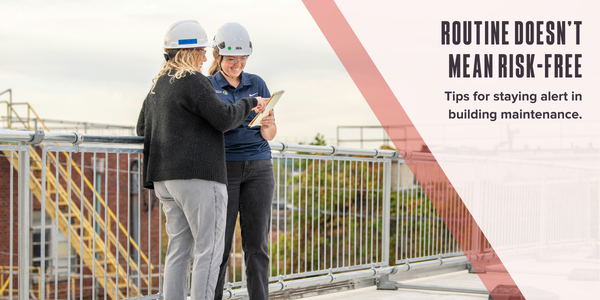
Routine doesn’t mean risk-free
By John Kenney, Cotney Consulting Group.
Tips for staying alert in building maintenance.
There’s a unique mindset that comes with building maintenance work. Unlike construction crews who move from project to project, maintenance technicians return to the same properties day after day. They know the buildings, understand the systems and learn the expected routine. But that familiarity can also create one of the most dangerous conditions on any jobsite: complacency.
Maintenance work rarely looks dramatic from the outside. It might be replacing ceiling tiles, fixing a door hinge, servicing HVAC units, changing lighting, repairing leaks or adjusting equipment. But behind those tasks are real hazards — electrical exposure, fall risks, confined spaces, awkward lifting, sharp edges, wet floors, chemical interactions and mechanical components that don’t forgive mistakes. When a task feels “simple,” that’s precisely when people let their guard down.
The danger of the “same old” mindset
In maintenance, it’s easy to assume nothing will go wrong because nothing went wrong last time. A technician may climb the same ladder, open the same access panel or service the same pump they’ve handled a hundred times before. That familiarity becomes muscle memory, and muscle memory can quietly override safety steps.
We’ve all seen it — a worker skipping lockout/tagout. They believe the equipment is “off,” performing a quick fix on a ladder that should have been moved, or using makeshift tools because the right one is in the truck. These shortcuts don’t come from recklessness. They come from routine. And routine doesn’t protect anyone when conditions shift unexpectedly.
Understanding the real risks of maintenance work
Every building has its own hidden dangers. Whether it’s commercial, residential or industrial, maintenance teams encounter a wide variety of hazards:
- Electrical panels, lighting circuits and machinery resets
- Slippery floors or wet areas near plumbing repairs
- Dust, mold or debris in ceiling spaces or mechanical rooms
- Ladders and elevated access points
- Confined or poorly ventilated spaces
- Heavy lifting during equipment replacements
These risks don’t disappear because the technician knows the space. If anything, familiarity can mask just how unpredictable building environments can be, especially when interacting systems overlap.
Slow down to speed up
Maintenance workers often feel pressure to move quickly — especially when tenants, customers or workers are waiting on a repair. But rushing is a leading cause of accidents.
The safest technicians share a common habit: they take a moment before each task to evaluate the environment. They look for wet floors, live circuits, unstable surfaces, missing guards or environmental changes since their last visit. They check that tools and PPE match the task. That 30-second pause is often the difference between a routine fix and an incident report.
Re-emphasize the basics repeatedly
Because maintenance tasks vary so widely, the basics matter more than anything:
- Always test before you touch — especially with electrical systems
- Never assume equipment is de-energized
- Use ladders correctly and never “make do” with unsafe positioning
- Wear PPE even when the job feels minor
- Communicate about hazards, especially in occupied buildings
- Maintain clear walkways and work zones
These practices are simple, but they’re often skipped when tasks feel too routine. Reinforcement from supervisors and leads ensures that consistency doesn’t slip.
Document, communicate and train
Maintenance departments thrive when they operate with the same discipline as a construction site. That means:
- Clear service logs
- Defined SOPs
- Documented hazards
- Toolbox talks tailored to recent issues
- Routine safety refreshers
Technicians should know which tasks require additional personnel, when to escalate hazards and when to stop work entirely. A culture that values communication prevents minor problems from becoming emergencies.
Familiar doesn’t equal safe
Building maintenance teams are the unseen backbone of many facilities. They keep operations running, solve problems before anyone notices and protect the lifespan of every central system. But their work is only safe when they treat every task — even the smallest — with the respect it deserves.
Routine tasks still carry real risks. And when maintenance workers stay alert, follow their process and recognize how easily familiarity can become complacency, they protect not just themselves but everyone who relies on the building.
The next time you walk into a mechanical room, climb a ladder or open a familiar access panel, take a moment to reset. Treat the task as if it’s the first time — that mindset is what keeps maintenance professionals safe day after day.
Learn more about Cotney Consulting Group in their Coffee Shop Directory or visit www.cotneyconsulting.com.
Recommended For You
Protecting Workers: Personal Protective Equipment (PPE) for a Safe Workplace – Part One
Read More ...
Why hard hats matter on the roof
Read More ...
How to Pass an OSHA Inspection
Read More ...
UP TO THE MINUTE






Comments
Leave a Reply
Have an account? Login to leave a comment!
Sign In