









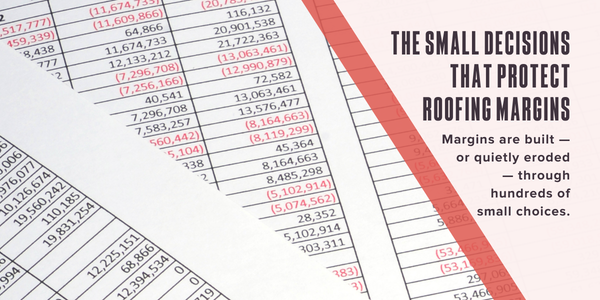
The small decisions that protect roofing margins
By John Kenney, Cotney Consulting Group.
Margins are built — or quietly eroded — through hundreds of small choices.
When contractors talk about profitability, the conversation usually turns to estimating, labor costs, material pricing or overhead. Those are all important pieces of the equation, but after spending more than four decades in this industry, I've come to believe that margins are rarely won or lost because of one major decision. They're built — or quietly eroded — through hundreds of small ones.
That's one of the reasons profitability can be so difficult to understand. When a project underperforms, everyone naturally looks for the big event that caused it. Was the estimate too low? Did material prices increase? Did weather delay production? Those things certainly affect a project, but more often than not, they expose problems that have been developing for weeks.
Profit rarely disappears all at once. It slips away one decision at a time.
I've walked onto projects where the estimate was solid, the crews were experienced and the customer was satisfied, yet the financial results still fell short of expectations. Looking back, there wasn't a single catastrophic mistake. Instead, there was a long list of small operational decisions that, individually, seemed insignificant.
A delivery wasn't confirmed the day before. A crew waited thirty minutes for equipment. A material shortage required an extra supplier trip. A change order wasn't documented until the following week. A project manager postponed a site visit because another job demanded attention. None of those moments ruined the project. Together, they changed the outcome.
That's what makes operational discipline so important. The companies that consistently outperform their competitors aren't necessarily making better decisions dramatically. They're making fewer poor ones, andthey're catching the small issues before they begin affecting production.
One observation has stayed with me throughout my career. Roofing companies rarely lose money because people don't care. Most of the time, everyone involved is working hard and trying to do the right thing. The problem is that hard work cannot recover every small decision that wasn't made when it should have been.
Eventually, those decisions begin stacking on top of one another. A delayed purchase order affects material deliveries. Material deliveries affect crew productivity. Reduced productivity changes labor performance.Labor performance affects project schedules. Schedule changes create customer pressure. Customer pressure increases management time. By the end of the project, accounting reports a margin problem.
But accounting is only measuring the result. The real causes happened much earlier.
I've always believed that one of the most valuable habits a contractor can develop is recognizing operational friction. Every roofing company experiences it. Crews waiting for information. Project managers chasingpaperwork instead of managing production. Estimators answering questions that should have been resolved during the handoff. Dispatchers reshuffling schedules because yesterday's decisions created today's problems.
Friction isn't always dramatic. It's usually quiet. And because it's quiet, companies often learn to live with it rather than eliminate it.
The strongest operations think differently. They understand that every unnecessary interruption has a cost, even when nobody immediately notices it—five minutes waiting for a forklift. Ten minutes looking for materialsand fifteen minutes discussing an issue that should have been clarified before work started. Individually, those moments seem harmless. Across dozens of projects over the course of a year, they add up to thousands of lost labor hours. That's where margins disappear.
I've noticed something else over the years. High-performing companies don't obsess over productivity because they expect people to work faster. They focus on improving efficiency by removing obstacles that prevent people from doing the work they're already capable of performing.
There's an important distinction. You can demand more effort from a crew. Or you can create conditions that allow the crew to perform at its best. The second approach is almost always more profitable.
One lesson experience teaches is that operational excellence isn't built through heroic recoveries. It's built through consistent attention to details that most people overlook. Strong project managers follow up on open issues before they become urgent. Foremen think ahead instead of simply reacting to what's in front of them. Estimators communicate assumptions instead of assuming others understand them. Owners create systems that reduce uncertainty instead of relying on experience to fill the gaps.
Those actions don't attract much attention. They rarely become success stories. But they're the reason successful companies remain successful. I've also found that profitable contractors ask different questions during project reviews. Instead of asking, "Why did we lose money?" they ask, "What small decisions made this project easier—or harder—to execute?"
That question shifts the conversation away from blame and toward learning. Over time, those lessons become part of the company's operating habits. The organization becomes a little sharper. A little more consistent. A little more disciplined. Eventually, those small improvements begin showing up in financial performance.
People often assume profitable companies have discovered some secret formula. In my experience, the formula is much simpler than that. They've become better at protecting their margins one decision at a time. I'venever believed that profitability is created in the accounting office. Accounting tells you what happened. Profitability is created every day in estimating meetings, project handoffs, scheduling discussions, purchasingdecisions, jobsite planning and hundreds of conversations that most people never think about again.
Those conversations shape the work. The work shapes the results. And the results shape the business.
The longer I've been in this industry, the more convinced I've become that operational excellence isn't about making one brilliant decision. It's about making the next small decision a little better than the last one.Because roofing margins are rarely protected by one big moment. They're protected by hundreds of small ones that nobody notices until they're missing.
Learn more about Cotney Consulting Group in their Coffee Shop Directory or visit www.cotneyconsulting.com.
Recommended For You

The Crucial Transition: From Peer to Supervisor in the Roofing Industry
Read More ...
How 2025 is shaping up to be a major year for metal
Read More ...
Making the Call – How to Decide When to Repair or Replace a Roof
Read More ...
UP TO THE MINUTE







Comments
Leave a Reply
Have an account? Login to leave a comment!
Sign In